
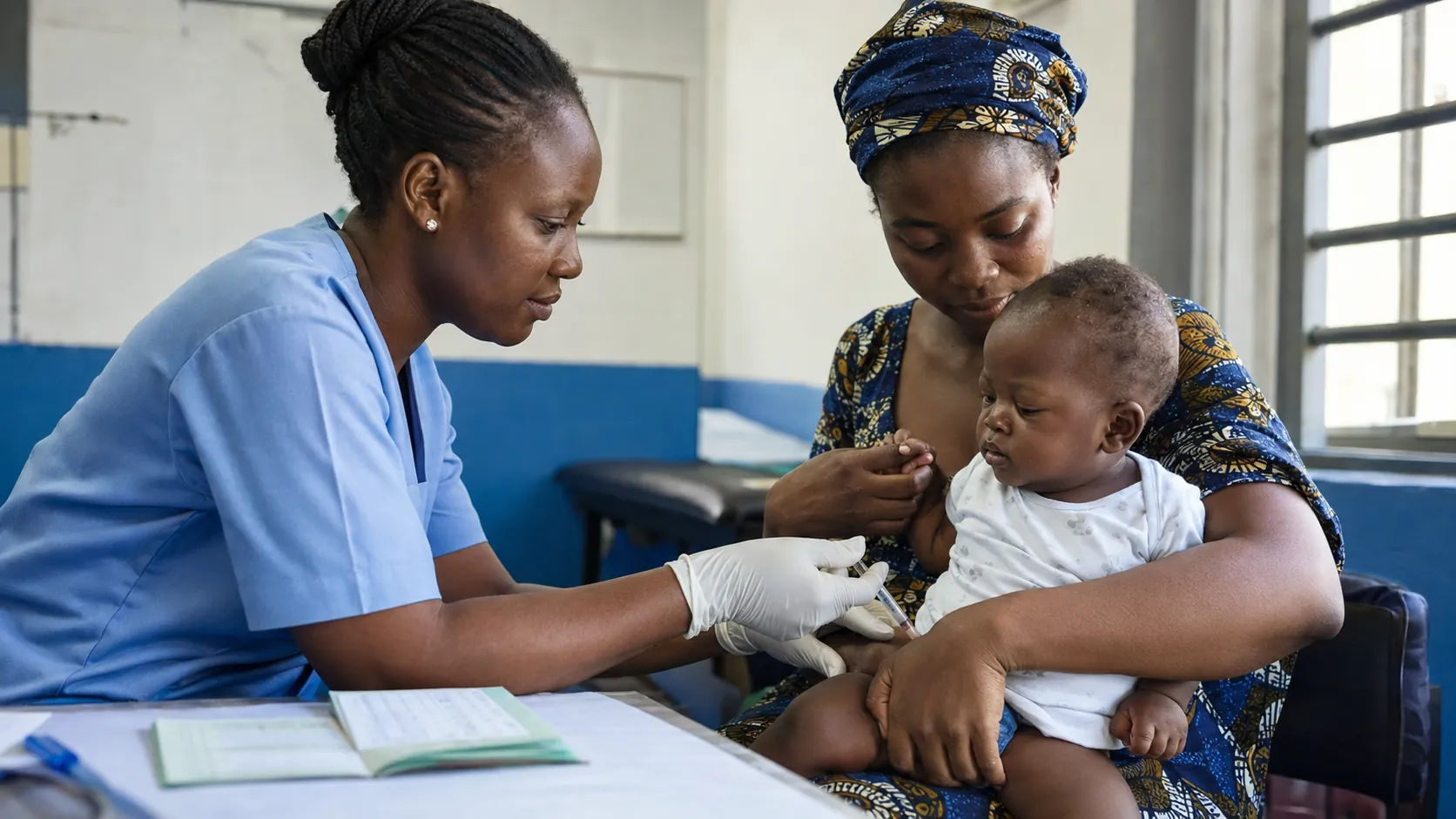
Nigeria's National Programme on Immunisation protects children against eleven diseases, several of which used to kill or disable children routinely and now barely appear. The schedule is well designed. Where it fails, it usually fails because a parent misses a visit, is told something incorrect at a chemist, or believes the doses have to be restarted after a gap.
This is the schedule in full, with what each vaccine is for.
At birth
BCG. Protects against the severe forms of tuberculosis in young children, particularly tuberculous meningitis. Given as an intradermal injection, usually in the upper arm. It produces a small sore that scabs and heals over several weeks and leaves a scar. That reaction is normal and expected. Do not apply anything to it and do not squeeze it.
Oral polio vaccine, zero dose. The first protection against poliomyelitis, given as drops in the mouth.
Hepatitis B birth dose. Must be given within the first 24 hours of life to be fully effective. Hepatitis B transmitted from mother to child during birth very often becomes a lifelong chronic infection with a real risk of liver cirrhosis and liver cancer decades later. This single dose, given on the first day, prevents that.
Six weeks
Pentavalent 1. One injection covering five diseases: diphtheria, pertussis (whooping cough), tetanus, hepatitis B and haemophilus influenzae type b, which is a major cause of meningitis and pneumonia in small children.
Oral polio 1.
Pneumococcal conjugate vaccine 1. Against streptococcus pneumoniae, the leading bacterial cause of pneumonia, meningitis and severe ear infection in children.
Rotavirus 1. Against the commonest cause of severe diarrhoea and dehydration in infants. Given orally.
Ten weeks
Pentavalent 2, oral polio 2, pneumococcal 2, rotavirus 2. The second dose of each. Multi dose vaccines work by building the immune response in stages, which is why the second dose is not optional and why the interval between them matters.
Fourteen weeks
Pentavalent 3, oral polio 3, pneumococcal 3.
Inactivated polio vaccine. An injected polio vaccine given alongside the oral doses, which together give stronger and more reliable protection than either alone.
Six months
Vitamin A supplementation. Not a vaccine, but part of the schedule. Vitamin A deficiency remains a cause of childhood blindness and increases death rates from measles and diarrhoea. Repeated every six months through early childhood.
Influenza vaccine where offered, from six months of age.
Nine months
Measles, first dose. Measles is not a mild illness. It causes pneumonia, encephalitis, severe diarrhoea and death, and it suppresses the immune system for months afterwards, leaving the child vulnerable to other infections. Outbreaks in Nigeria are driven overwhelmingly by unvaccinated children.
Yellow fever. A single dose gives long lasting protection against a disease that is endemic in Nigeria and has no specific treatment.
Meningitis A. Against the meningococcal strain responsible for the epidemics that periodically sweep the northern meningitis belt.
Fifteen months
Measles, second dose. The first dose does not produce immunity in every child. The second dose closes that gap and is the reason measles outbreaks are stopped rather than merely slowed. Skipping it is one of the most common failures in the whole schedule.
Additional vaccines available privately
These are not on the national schedule but are available at private facilities and are worth discussing with your paediatrician.
- Typhoid conjugate vaccine, from six months, and genuinely worth considering in Lagos
- Hepatitis A, from twelve months
- Varicella (chickenpox), from twelve months
- Meningococcal ACWY, broader coverage than meningitis A alone
- HPV vaccine, for adolescents from nine years, which prevents the infection that causes the large majority of cervical cancer
- Annual influenza vaccine
If your child has missed doses
This is the most important paragraph here. Missed doses are almost never restarted from the beginning. The immune system does not forget the doses already given. A child who had pentavalent 1 at six weeks and then nothing for a year needs pentavalent 2 and 3, not the whole course again.
Bring the immunisation card, or come without it if it has been lost, and a paediatrician will construct a catch up schedule. Almost every child can be brought fully up to date. The only thing that makes catch up harder is delay, so do not let embarrassment about the gap turn into a longer gap.
What is normal after a vaccination
Expect some of the following in the 48 hours afterwards, and none of it is a reason for concern.
- Mild fever, which responds to paracetamol at the correct weight based dose
- Soreness, redness or a small firm lump at the injection site
- Irritability, poor feeding or extra sleepiness for a day
- A slowly developing sore at the BCG site over several weeks
Bring your child in without delay if there is a high fever that does not settle, a fit, difficulty breathing, swelling of the face or lips, a rash spreading over the body, or persistent inconsolable crying beyond a few hours. These are uncommon, and they are the reason immunisation is given in a clinical setting rather than anywhere else.
The objections worth answering directly
"He is too small this week." Vaccines are scheduled by age, not by weight, and a small baby is at greater risk from these diseases, not less. Only a genuinely acute illness with high fever justifies postponement, and a runny nose does not.
"He reacted last time." Fever and soreness after a dose are the expected immune response, not an allergy, and they do not contraindicate the next dose. Tell the clinician exactly what happened and they will tell you whether it matters.
"We will do them all together later." The intervals exist because the immune response needs time between doses. Compressing them reduces protection, and the months in between are exactly when an unprotected child is exposed.
Keep the card. It will be asked for at school registration, at travel, and at every subsequent hospital visit, and reconstructing a lost immunisation history is far harder than keeping a small piece of paper.
If this describes your situation
Book a consultation at Magodo and bring previous results, scans and a current medication list where relevant. The hospital is open 24 hours.