
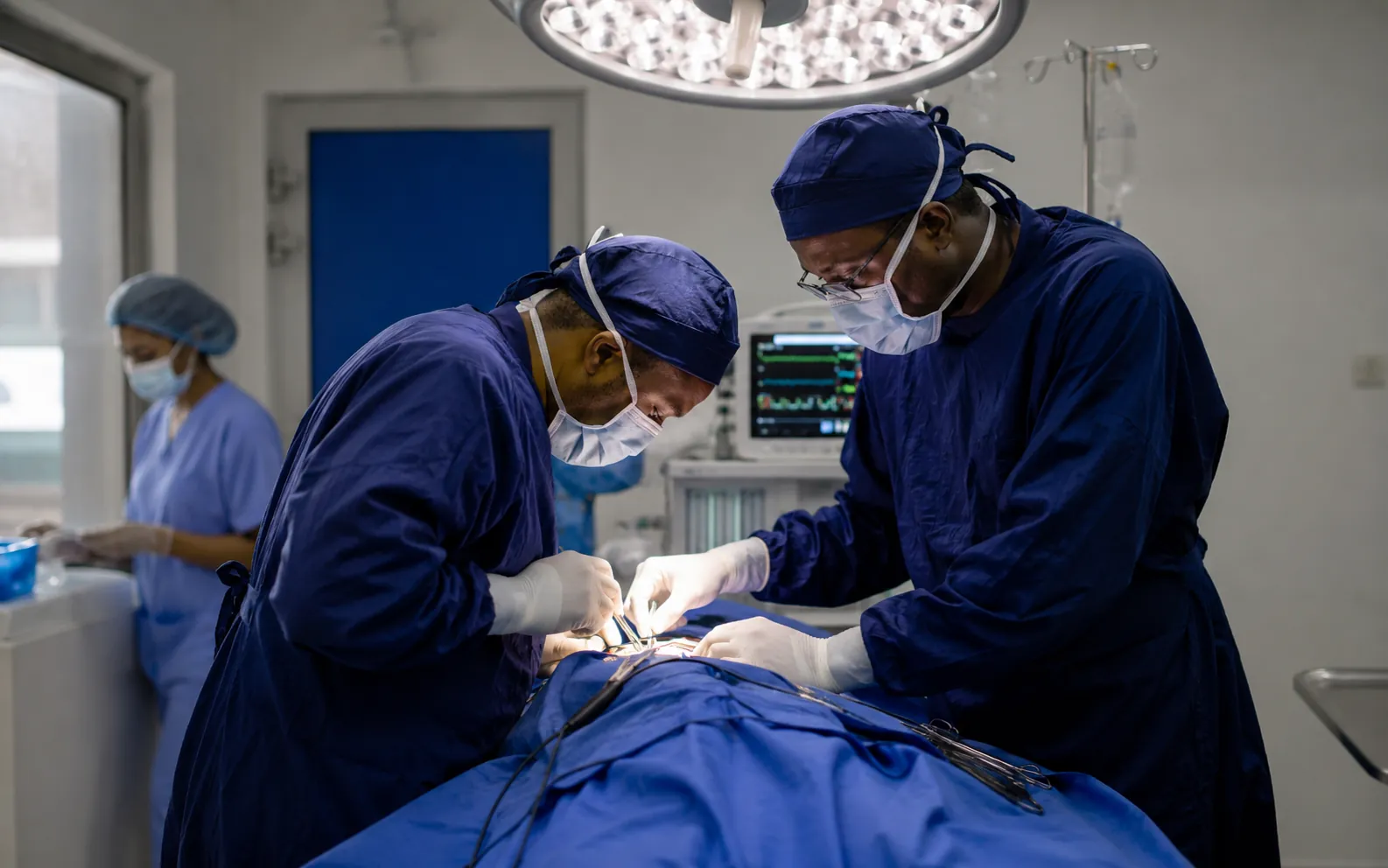
General and Minimal Access Surgery
Appendectomy, hernia repair, exploratory laparotomy and minimal access procedures, with a theatre that is prepared around the clock.
Surgery is the point at which a hospital's real capability shows. It is not the equipment on display in the corridor, it is whether the theatre can be opened at three in the morning, whether blood is available, and whether someone is watching the patient closely for the twenty four hours afterwards.
SkyHigh performs the full range of general surgery for a secondary care hospital, both planned and emergency. In the first year under current management the hospital recorded over a hundred completed procedures, including appendectomies and exploratory laparotomies alongside the obstetric and gynaecological operations.
What we operate on
Our general surgeons handle abdominal emergencies, hernias in all their common forms, soft tissue and skin lesions, breast lumps, anorectal conditions and a range of day case procedures.
- Appendectomy, open and laparoscopic where suitable
- Inguinal, umbilical, incisional and epigastric hernia repair
- Exploratory laparotomy for acute abdominal emergencies
- Cholecystectomy for gallstone disease
- Breast lump excision and biopsy
- Haemorrhoidectomy, fistula and fissure surgery
- Excision of lipomas, cysts and soft tissue masses
- Wound debridement and management of diabetic foot
Why minimal access matters here
Minimal access surgery, often called keyhole or laparoscopic surgery, reaches the same organs through several small incisions rather than one long one. The operation inside is broadly similar. What changes is everything that comes afterwards.
Smaller incisions mean less post operative pain, a much lower rate of wound infection, less scarring, and a shorter stay. For a patient in Lagos who cannot afford a week away from work, and for whom every additional inpatient night is both a cost and an infection risk, that difference is not cosmetic.
Not every case is suitable. Extensive adhesions from previous surgery, certain emergencies, and some anatomical findings mean an open approach is safer. Your surgeon will tell you which approach is planned and under what circumstances it would be converted during the operation.
Preparing for surgery
Before any planned operation you will have a pre operative assessment covering your medical history, current medications, previous anaesthetic experiences, allergies, and a set of investigations that typically includes full blood count, genotype, clotting screen, electrolytes and urea, blood grouping and cross match, and an electrocardiogram in older patients or those with cardiac history.
You will be told exactly when to stop eating and drinking. This is not a formality. Anaesthesia on a full stomach carries a genuine risk of aspiration, and an operation will be postponed if the fasting instruction has not been followed.
Certain medications need to be stopped or adjusted beforehand, particularly blood thinners, some diabetes medications and some herbal preparations. Tell us everything you are taking, including anything bought over the counter or prepared traditionally, because we cannot manage a bleeding risk we do not know about.
Recovery and going home
After the operation you are monitored in recovery until you are fully awake and your observations are stable, then moved to the ward. Pain relief is prescribed on a schedule rather than only when you ask for it, because pain that is controlled early is easier to control.
Most day case procedures go home the same evening with a responsible adult. Appendectomy and hernia repair typically mean one to two nights. Laparotomy is longer and depends entirely on what was found. Before you leave you will be given a discharge summary, medications, wound care instructions, a clear list of warning signs, and a review date.
Your care pathway
This is the sequence, in order, so you know what comes next at every point.
- 1
Surgical consultation
Examination, imaging and a frank discussion of whether an operation is actually the right answer.
- 2
Pre operative assessment
Bloods, cross match, anaesthetic review and fitness assessment, all done on site.
- 3
Consent
Written consent after the procedure, alternatives, benefits and specific risks have been explained in plain language.
- 4
Operation
In our theatre with a dedicated anaesthetist and full monitoring.
- 5
Ward recovery
Scheduled pain relief, early mobilisation, wound checks and observation.
- 6
Review
Wound review and removal of sutures where used, plus a longer term follow up where the condition needs it.
What this will cost you
Cost depends on what you actually need, and we would rather quote you accurately than post a figure that turns out not to apply. Call the front desk or send us a message with what you have been told so far, and we will give you the figure before anything is booked. If you hold an HMO plan we will check what it covers for this specific treatment first.
Common questions
How long will I be off work?
It depends on the procedure and your job. A laparoscopic hernia repair in an office worker may mean one to two weeks. An open repair in someone doing physical work may mean six. Your surgeon will give you a figure specific to your case.
Will I be asleep for the operation?
Most abdominal surgery is done under general anaesthesia. Some procedures are done under spinal or local anaesthesia. The anaesthetist will discuss which applies to you and why.
Do I need to arrange blood?
For most planned procedures we group and save rather than transfuse. For larger operations we cross match units in advance. The team will tell you clearly if donors are required.
Who you will see
Care in this department is coordinated by our clinical team at Magodo, with specialist input arranged where your condition calls for it. If you would like to be seen by a particular clinician, say so when you book and we will arrange it where the clinic schedule allows.

Next step
Speak to someone now, or book a time that suits you
The front desk answers at every hour of the day. If it is urgent, call. If it can wait, the booking form takes about two minutes.